Tell us about the job
Takes about a minute. No obligation.
A mini-split compressor that fails in July here has spent most of the year parked. Homes in Wayne County, NY run cooling about two months a year, from July through August. Refrigerant seals dry out during long idle periods, and contactor contacts corrode when nothing is cycling through them. A contractor diagnosing a Wayne County unit checks those dormant-season failure points before looking at wear from runtime, because the compressor simply has not run enough hours to fail from load alone.
Mini-split systems fitted into older homes run on circuits and line sets that were put in for something else entirely. Half the homes in Wayne County, New York were built in 1968 or earlier (2020-2024 ACS 5-year). A contractor opening a unit here has to account for what the wall behind it actually contains: wiring that may have been adapted more than once, and line sets whose condition shapes what the repair requires. If a compressor or control board needs replacing, the surrounding infrastructure decides how straightforward that swap is.
The Parts of a Mini-split a Contractor Checks First
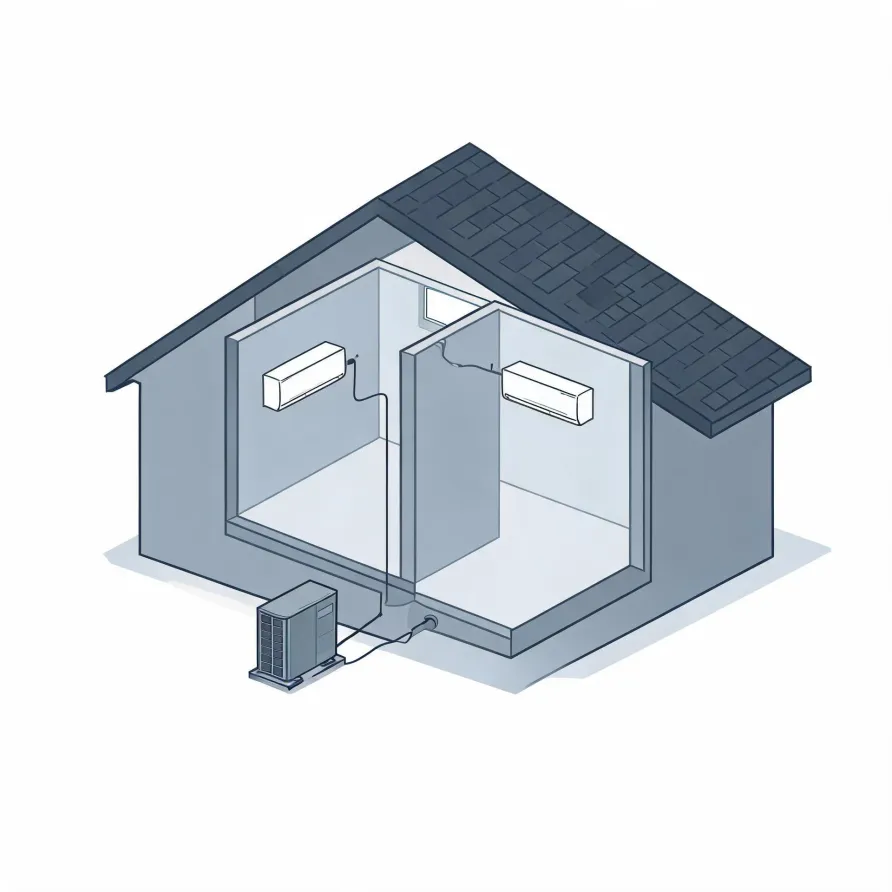
The indoor air handler is usually the first place a contractor looks. It mounts high on a wall inside the room, pulls in room air, and delivers conditioned air back out. When it fails, the room gets no airflow, or airflow arrives at the wrong temperature. The evaporator coil inside it and the blower wheel that spins behind the front panel are both common sources of trouble.
Outside, the condenser unit houses the compressor and the condenser coil. The compressor is the part that does the hardest mechanical work, and it is the piece a contractor will test carefully when the system runs but produces no real change in the room. The refrigerant line set and the condensate drain line run between the two units, and both can be the source of a problem that looks like it belongs somewhere else.
The drawing shows the general layout of a mini-split system, and a licensed contractor determines which components apply to your specific house and situation.
Get matched in Wayne CountyWayne County, by the numbers
129 severe weather events were recorded in Wayne County, New York between 2015 and 2024.
NOAA National Centers for Environmental Information, Storm Events Database, bulk CSV export, events 2015-01-01 through 2024-12-31.Half the homes in Wayne County, New York were built in 1968 or earlier (2020-2024 ACS 5-year).
U.S. Census Bureau, 2020-2024 American Community Survey 5-Year EstimatesWayne County, New York holds 42,570 housing units (2020-2024 ACS 5-year).
U.S. Census Bureau, 2020-2024 American Community Survey 5-Year EstimatesOwners occupy 79.9% of the occupied homes in Wayne County, New York (2020-2024 ACS 5-year).
U.S. Census Bureau, 2020-2024 American Community Survey 5-Year EstimatesSevere Weather Events in Wayne County
Extreme weather puts real hours on heating and cooling equipment. How hard a mini-split works over its life depends on what the local climate actually does, and that makes Wayne County's weather record a practical part of the repair picture.
129 severe weather events, 2015–2024. Source: NOAA National Centers for Environmental Information, Storm Events Database.