Tell us about the job
Takes about a minute. No obligation.
A contractor diagnosing a failed mini-split here starts by ruling out short-season failure modes: a unit that sat idle through a long winter and then could not start in July. Homes in Niagara County, NY run cooling about two months a year, from July through August. The compressor, the contactor, and the outdoor fan each cycle on and off across those weeks, accumulating wear that is real but contained. A refrigerant leak or a seized contactor on a first-call-of-summer unit often points to dormancy and age rather than compressor fatigue from continuous summer load.
Repair work on a mini-split in a house this old starts inside the unit, not on the permit. Half the homes in Niagara County, New York were built in 1958 or earlier (2020-2024 ACS 5-year). What that means for a contractor opening the system is a question about the specific components inside and whether the parts they take are still in production. A refrigerant valve or control board in a system serving prewar construction has a supply chain that narrows with age. That is where the repair scope gets set.
The Parts of a Mini-split a Contractor Checks First
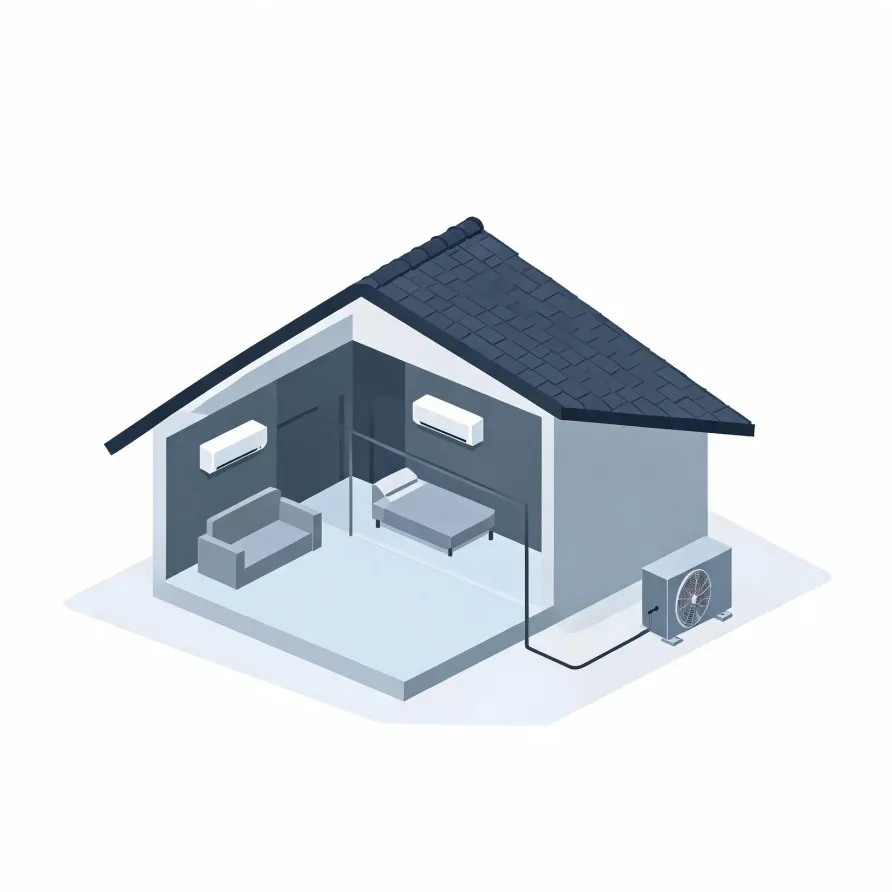
The indoor air handler mounts high on a wall inside the room and is the piece a homeowner notices most. It draws in room air, passes it across the coil, and pushes conditioned air back out. When this unit is the source of trouble, a contractor looks at the coil, the fan, the drain line, and the sensors it relies on to read the room.
The outdoor condenser sits outside the house on a pad or bracket and holds the compressor, the outdoor coil, and the fan that moves air across it. A refrigerant line set and a condensate drain run between the two units through a small opening in the wall. The line set, the electrical connections at each end, and the condensate path are all points a contractor checks when tracing a fault.
The drawing shows a typical layout, and a licensed contractor determines what applies to your specific installation.
Get matched in Niagara CountyNiagara County, by the numbers
121 severe weather events were recorded in Niagara County, New York between 2015 and 2024.
NOAA National Centers for Environmental Information, Storm Events Database, bulk CSV export, events 2015-01-01 through 2024-12-31.Half the homes in Niagara County, New York were built in 1958 or earlier (2020-2024 ACS 5-year).
U.S. Census Bureau, 2020-2024 American Community Survey 5-Year EstimatesNiagara County, New York holds 100,446 housing units (2020-2024 ACS 5-year).
U.S. Census Bureau, 2020-2024 American Community Survey 5-Year EstimatesOwners occupy 71.2% of the occupied homes in Niagara County, New York (2020-2024 ACS 5-year).
U.S. Census Bureau, 2020-2024 American Community Survey 5-Year EstimatesSevere Weather Events in Niagara County
Extreme weather puts real load on heating and cooling equipment, and repeated stress on a mini-split system shortens the intervals between service calls. How hard that equipment works is a local fact, and the record below reflects the conditions it runs in.
121 severe weather events, 2015–2024. Source: NOAA National Centers for Environmental Information, Storm Events Database.